
Freely Battle 2026: Judge Ryutaro's Feedback
Judge Ryutaro Hidaka shares his sincere take on the first edition of Freely Battle and his concrete tips to keep improving.
ASTUCES & TIPS
Freely EN
6/15/20263 min read
Freely Battle 2026: Judge Ryutaro's Feedback
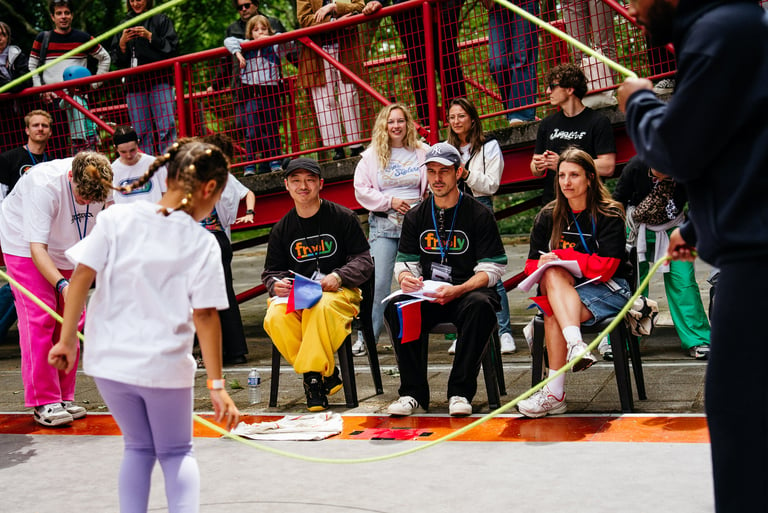
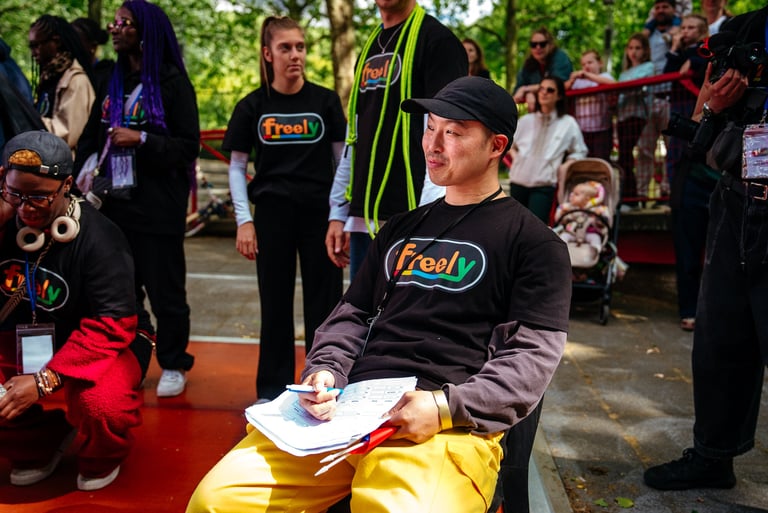
After the first edition of Freely Battle 2026 at La Villette, Japanese judge Ryutaro Hidaka from Jumpforall took the time to write a full piece of feedback for the participants. A sincere text, both caring and demanding, which we're sharing here for every young jumper who wants to progress.
His Advice for Progressing
"I'm truly happy that we were able to organise freely FRANCE"
Before the advice, Ryutaro first wants to salute the courage of the participants in the Challenge category. Stepping onto the floor for a first battle, handling the pressure and the stress, already deserves respect in his eyes.
He likes to recall one phrase: in competition, "you walk away with either success or progress." Those who don't win still leave with new experiences and new goals.
He also highlights the quality of the Advanced category, where the way participants lived the music and connected with the crowd impressed him.
It was hard to believe, he says, that this was a first edition, the overall level was that high. Hence his sincere wish: that this kind of event keeps going, even as small regular battles, because what matters is meeting, challenging each other and progressing together.
Entering the Battle
For Ryutaro, the battle begins the moment you hear "Battle Start," before the first jump. Attitude, presence and awareness of your opponent can already be worked on at that instant, beginners included.
Being Aware of Your Opponent
He sometimes felt a lack of attention toward the opponent during the moves, with some jumpers even looking at the floor, which felt more like a showcase than a battle. Yet watching the other, communicating with them and answering them is an integral part of the confrontation.
The Dance Aspect
The level in Advance was high, but he noticed a gap between participants with a dance background and the others. His message is clear: Double Dutch is not only about dance. Technique, footwork, rhythm and creativity can also make the difference, and he'd love to see more styles coexist.
Rope Entries and Exits
Too often used without intention, these transitions are actually essential: they create breathing room and set up the strong moments. Perfectly synced with the music, they become remarkably effective.
Speed Steps
A speed step has to be committed to fully. Done hesitantly, it's sometimes better to skip it altogether. When you use one, you need to know why, and give it a precise function in the way the routine is built.
Acrobatics, Beginnings and Endings
The same principle applies to acrobatics: think as much about how you enter and exit them as about the move itself. The beginnings and endings of a routine are often what the crowd remembers most.
Contrasts and Changes in Rhythm
Speeding up, slowing down, holding a pause then bursting back: managing contrasts in rhythm makes a routine far more compelling. Ryutaro found some routines too constant this year, and would like to see more tension and release.
"I can't wait to see what comes next"
For Ryutaro, progressing isn't only about learning harder acrobatics and combinations: it comes through awareness of your opponent, connection with the music, and intention behind every movement. Double Dutch, he concludes, is also a way to express yourself through music, movement and exchange with others.
He thanks the participants for their energy and their courage, and shares one simple thing: "I can't wait to see what comes next."
Curious about another perspective on this same edition? Check out judge Loic's feedback too
Do you want to see the battle ? Check out our gallery
FREELY BATTLE
Stay loose and enjoy the moment.
Suscribe to the Newsletter !
© 2026. All rights reserved.